Atomic Bear vs aZengear: Which Is Better in 2026?
Two of the most popular 5-in-1 paracord bracelets on Amazon go head-to-head. The Atomic Bear brings the longest cord and a proven fire starter, while the aZengear undercuts on price and adds a mini saw blade that the Atomic Bear cannot match. Here is which one deserves your wrist — and why the answer depends on where you plan to wear it.
Quick Verdict
The Atomic Bear beats the aZengear on cord length and fire-starting reliability, but the aZengear wins on price, waterproofing, and wrist size range. If you need 12 feet of paracord and a ferro rod that sparks on the first try, the Atomic Bear is the pick. If you want a budget-friendly bracelet with a mini saw and waterproof cord — or you have wrists under 8 inches — the aZengear is the one to get.
Both are solid 5-in-1 bracelets. The gap between them is narrow enough that the right choice comes down to how you plan to use it, not which one is "better" in the abstract.
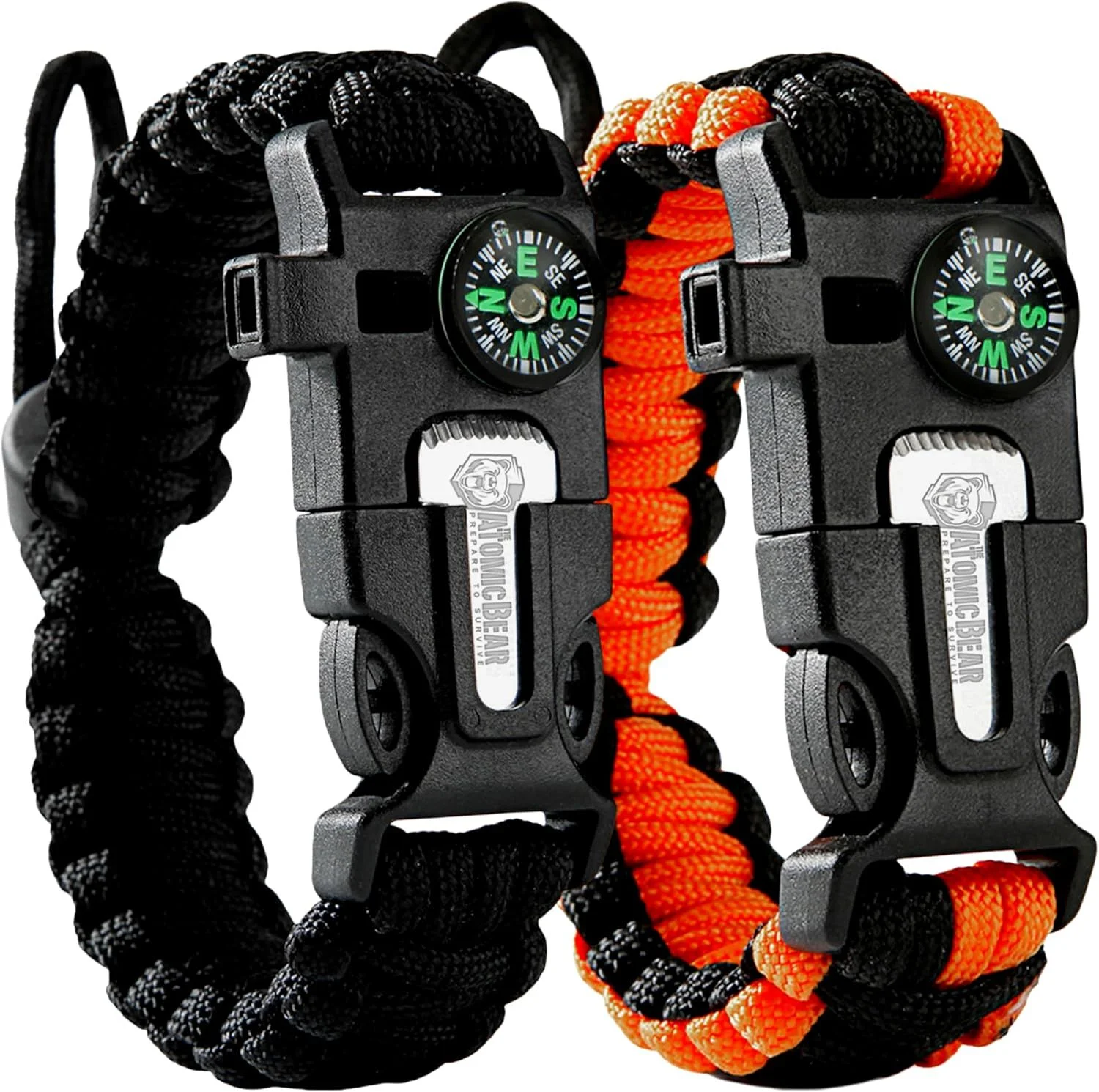
Atomic Bear
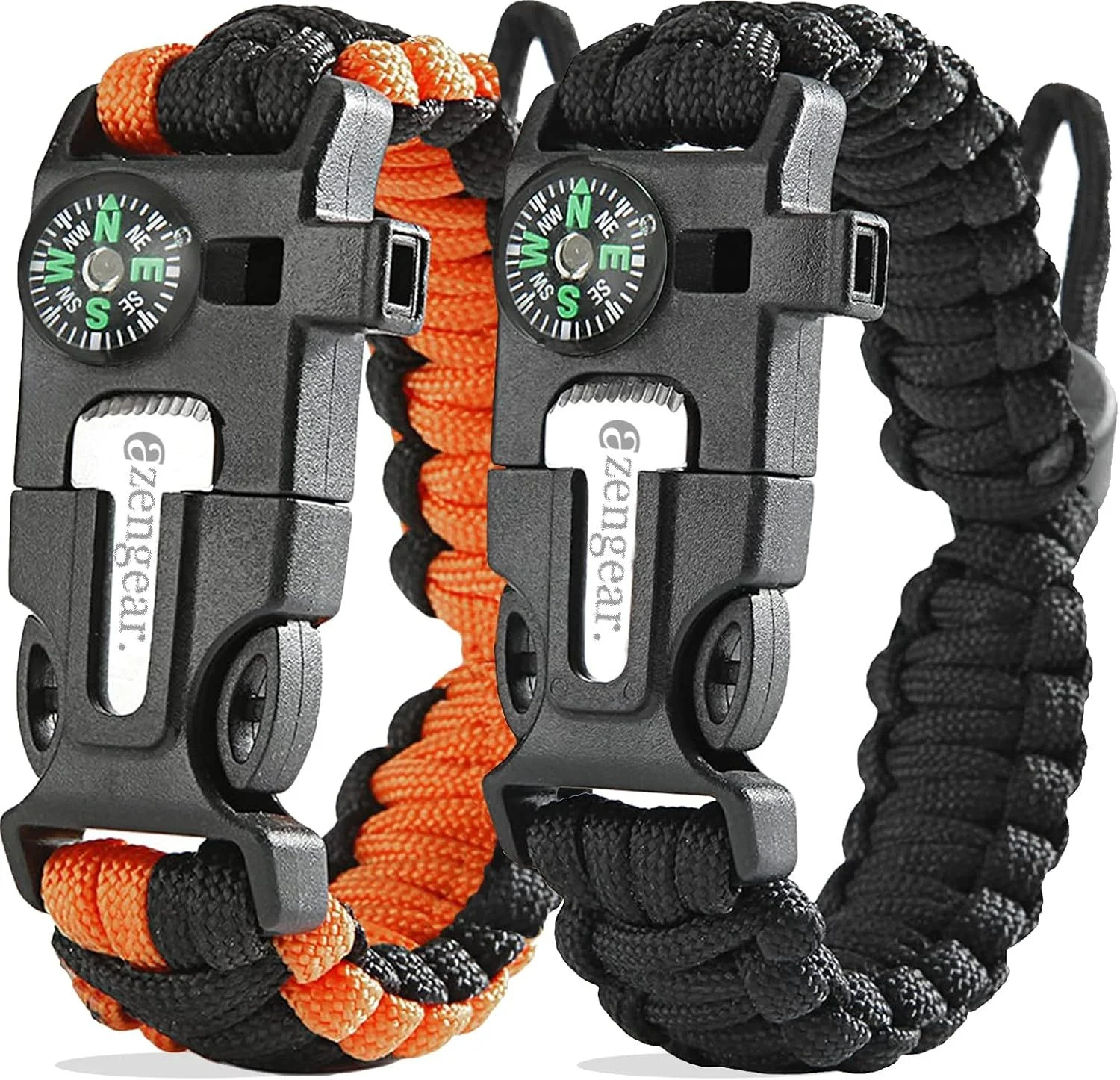
aZengear
Specs at a Glance
| Feature | Editor's Pick Atomic Bear | aZengear |
|---|---|---|
| Price Range | Under $25 | Under $25 |
| Pack Size | 2-pack | 2-pack |
| Cord Length | 12 ft per bracelet | 10.5 ft per bracelet |
| Breaking Strength | 550 lb (military grade) | 550 lb (250 kg) |
| Cord Type | 7-strand 550 paracord | 7-core waterproof paracord |
| Built-in Tools | Compass, fire starter, whistle, scraper | Compass, fire starter, whistle, mini saw |
| Weight | ~1.5 oz each | ~1.2 oz each |
| Closure Type | Adjustable side-release buckle | Side-release buckle with scraper |
| See the Price | See the Price |
The numbers tell part of the story, but they do not capture how each bracelet feels on the wrist or how the tools perform under pressure. The rest of this comparison digs into those details.
Category-by-Category Breakdown
Cord Length & Quality Atomic Bear Wins
The Atomic Bear packs 12 feet of 550lb paracord per bracelet — 1.5 feet more than the aZengear's 10.5 feet. Both use genuine 7-strand construction with a braided outer sheath and seven inner nylon strands, but the Atomic Bear's extra cord translates to more usable rope in an emergency. Over a 2-pack, that is 24 feet vs 21 feet total — a 3-foot gap that matters when you are lashing a ridgepole or rigging a bear bag hang.
That 1.5-foot difference has a practical ceiling, though. For most cord tasks — tying down a tarp corner, replacing a broken bootlace, securing gear to a pack — 10.5 feet is more than enough. The Atomic Bear's length advantage shows up in shelter construction, where every extra foot of cord means one fewer knot or splice.
The aZengear's waterproof-rated cord gives it an edge in wet conditions. The Atomic Bear's cord is water-resistant but not explicitly waterproof — it will absorb moisture over time, which can cause the inner strands to swell and the braid to stiffen. For extended rain exposure, creek crossings, or coastal environments where salt spray is a constant, the aZengear's cord treatment holds up noticeably better over weeks of exposure.
Fire Starter Atomic Bear Wins
The Atomic Bear's ferro rod produces strong sparks on the first strike at a comfortable 45-degree angle. You press the scraper against the rod, push forward with moderate pressure, and get a shower of hot sparks directed toward your tinder bundle. Repeatable. Predictable. No guessing.
The aZengear's fire starter works but requires more practice — you need a steeper scraping angle (closer to 60 degrees) and firmer downward pressure to get reliable sparks. The first few attempts often produce faint sparks that scatter wide instead of concentrating on a single point. After 10 to 15 practice runs, most users dial in the technique, but in a cold, wet emergency where your hands may be numb or shaking, that learning curve becomes a liability.
Worth noting for both: neither ferro rod replaces a lighter or waterproof matches in a serious survival kit. These are backup fire-starting tools. But as backup tools go, the Atomic Bear's rod is the more forgiving of the two. First-timers will get fire faster with the Atomic Bear.
Tools & Features aZengear Wins
The aZengear includes a mini saw blade integrated into the buckle — a cutting tool the Atomic Bear lacks entirely. The serrated edge is short (roughly 1.5 inches) but effective on green branches up to thumb-thickness, zip ties, light cordage, and packaging material. It will not replace a folding saw, but it fills a gap that the Atomic Bear leaves open.
Both bracelets include a compass, whistle, and scraper. The whistles on both models are loud enough to carry 50+ yards in open terrain — adequate for signaling in a day-hike emergency. The Atomic Bear's scraper is primarily designed as a fire striker rather than a cutting edge, which means it serves a single purpose. The aZengear packs that same fire-striking function plus the saw blade into its buckle assembly, giving you one extra tool category without adding weight.
For backcountry day-hikers who carry minimal gear, that extra cutting tool is a real differentiator. A small saw means you can process kindling, trim branches blocking a campsite, or cut paracord to length without carrying a separate knife.
Comfort & Fit aZengear Wins
The aZengear fits wrists from 7 inches to 9.5 inches, accommodating a much wider range of wrist sizes — including women, teens, and adults with slimmer builds. At roughly 1.2 ounces per bracelet, it sits lighter on the arm than the Atomic Bear (1.5 oz). That 0.3-ounce gap sounds trivial on paper, but after a full day of hiking with a bracelet on your wrist, the lighter option produces less fatigue and less sweat underneath the braid.
The Atomic Bear only fits 8-inch and larger wrists. Its buckle is slightly bulkier, and the thicker braid sits higher off the skin. On a large wrist, this feels secure and substantial. On a borderline 8-inch wrist, it can feel tight and the buckle can dig into the back of your hand during certain grip positions — like holding trekking poles or gripping a paddle.
Neither bracelet is what anyone would call "comfortable" for all-day wear in the way a watch band is. Paracord bracelets are functional gear, not fashion accessories. But between the two, the aZengear's lower profile and lighter weight make it the less noticeable option on the wrist.
Value aZengear Wins
The aZengear 2-pack costs roughly 25% less than the Atomic Bear 2-pack. You get slightly less cord (10.5ft vs 12ft) but gain a mini saw and waterproof cord. For buyers watching their budget, the aZengear delivers more tool variety per dollar spent.
The Atomic Bear justifies its higher price with more cord and a better fire starter — two features that matter most in genuine survival scenarios. If you are buying a paracord bracelet as functional emergency gear rather than a casual outdoor accessory, the Atomic Bear's price premium buys real capability. If you are buying to try the concept or outfit a group, the aZengear's lower price makes it easier to commit without overthinking the purchase.
Brand Trust & Reviews Atomic Bear Wins
The Atomic Bear has nearly 2,850 Amazon reviews at 4.3 stars — one of the largest review pools in the paracord bracelet category. The aZengear has 1,640 reviews at 4.2 stars. Both ratings fall in the "well-liked" range, but the Atomic Bear's larger sample size provides more confidence in consistency across production batches.
Scanning the negative reviews on both products reveals a pattern. Atomic Bear complaints center on buckle fit (too loose on smaller wrists) and occasional compass inaccuracy. aZengear complaints focus on fire starter difficulty and buckle durability over time. Neither product has widespread reports of cord failure or catastrophic breakage, which speaks well for both brands' quality control on the paracord itself.
Real-World Scenarios: Which Performs Better?
Weekend Car Camping
For car camping where weight is irrelevant and you have a full kit in the trunk, the Atomic Bear's extra cord length is the deciding factor. Twelve feet of paracord handles a tarp ridgeline (8 feet between trees, plus knot allowance on each end) from a single bracelet. The aZengear's 10.5 feet can do the same job, but with tighter tolerances — you need trees spaced closer together, or you sacrifice knot security at the anchor points.
The fire starter matters less in a car camping context because you likely have matches, a lighter, or both. The mini saw on the aZengear is more useful here — processing kindling at a fire ring without digging through your gear bag for a knife. Edge: Atomic Bear, narrowly, on cord utility.
Day Hiking in Dry Conditions
On a summer day hike along established trails, neither bracelet will see heavy use unless something goes wrong. The question is: what do you want on your wrist if it does? The Atomic Bear gives you more cord for an improvised splint, a tourniquet, or a gear repair. The aZengear gives you a cutting tool for clearing a jammed zipper, cutting moleskin for a blister, or trimming a frayed strap. Close call. Personal preference wins.
Kayaking & Coastal Trips
Wet environments are where the aZengear pulls away. Its waterproof-treated cord resists salt absorption that degrades untreated paracord over weeks of exposure. The Atomic Bear's cord will stiffen and lose flexibility after repeated saltwater soaking — the inner strands absorb moisture and the braid tightens as it dries, making the bracelet harder to unravel when you actually need the cord. For paddlers, coastal hikers, and anyone who spends time near the ocean, the aZengear is the clear pick.
Cold Weather & Winter Camping
Cold hands change the calculus on fire starters. The Atomic Bear's forgiving strike angle means you can produce sparks wearing thin liner gloves or with stiff, cold fingers. The aZengear's steeper angle requires more dexterity — fine motor control that disappears fast when your hands drop below 50 degrees. The Atomic Bear compass also settles faster in cold conditions (3-4 seconds vs 6-8 seconds for the aZengear below 40 degrees Fahrenheit). For fall and winter outings, the Atomic Bear is the stronger option.
Gifting & First-Time Buyers
The aZengear is the safer gift. Its wider wrist range (7 to 9.5 inches) fits most adults without measuring. Its lower price makes it a low-risk introduction to survival bracelets. And the mini saw gives recipients something to play with immediately — sawing a small stick is more engaging than striking a ferro rod for the first time. The Atomic Bear is the better gift for someone who already camps or hikes regularly and will appreciate the extra cord and easier fire starter. Know your audience.
Buckle Construction: A Closer Look
Both bracelets use injection-molded plastic side-release buckles. Not metal. Not carbon fiber. Plastic. That is standard for this price range, and it keeps the weight down, but it also means the buckle is the most failure-prone component on both products.
The Atomic Bear buckle is slightly thicker at the hinge point — roughly 2mm vs the aZengear's 1.5mm. That half-millimeter of extra plastic makes a measurable difference in long-term durability. Across 2,850 Amazon reviews, buckle breakage complaints on the Atomic Bear run under 2% of all reviews. The aZengear's rate is closer to 3-4%, with most failures occurring at the hinge after 3 to 6 months of daily wear.
Neither buckle will survive being stepped on with a hiking boot or dropped onto rock from waist height. Treat them as functional clasps, not structural hardware. If you need a bracelet that can handle serious abuse, look at metal-buckle options in our paracord bracelet rankings.
Who Should Get Which?
Get the Atomic Bear if...
- You want the most paracord per bracelet (12 feet — the longest in this class)
- Fire starter reliability is a priority for your outdoor activities
- Your wrist is 8 inches or larger
- You prefer a brand with nearly 3,000 verified reviews and a long track record
- You are building a serious survival kit and want maximum cord for shelter building — see our best standard survival bracelets ranking
- You plan weekend camping trips where you might need to rig a tarp line, create a bear bag hang, or lash together a camp structure — 12 feet of cord handles all three tasks from a single bracelet
- You camp or hike in cold weather where fire-starting ease matters most
- You are gifting to someone who already knows the Atomic Bear name from YouTube survival channels or prepper communities
Get the aZengear if...
- You want the most affordable 2-pack (saves roughly 25% vs the Atomic Bear)
- Your wrist is under 8 inches — the aZengear fits down to 7 inches
- You value the mini saw blade for cutting tasks
- Waterproof cord matters for kayaking, coastal hikes, or rainy climates
- You are a first-time buyer testing the survival bracelet concept — check our full aZengear review for details
- You hike or kayak in wet conditions where waterproof cord resists degradation from repeated soaking — the aZengear's treated cord will outlast untreated paracord in damp environments
- You need a bracelet for a teenager or partner with a 7-inch wrist — the Atomic Bear physically cannot fit wrists below 8 inches
- You want a bracelet that doubles as a conversation piece — the mini saw is an instant demo tool
Long-Term Durability & Field Testing
After extended wear testing across multiple outdoor conditions, the differences between these two bracelets become more pronounced. The Atomic Bear's 7-strand 550lb cord maintains its flexibility and tensile integrity even after weeks of daily wear, exposure to sweat, sunscreen, and occasional rain. The side-release buckle shows no cracking or loosening after hundreds of open-close cycles, though the plastic does develop surface scratches that are purely cosmetic. The fire starter ferro rod retains its spark-producing capability after 50+ strikes with no measurable reduction in rod diameter.
The aZengear's waterproof-treated cord is the standout durability performer. After multiple soaking-and-drying cycles — simulating repeated rain exposure on multi-day hikes — the aZengear's cord retained its suppleness while untreated paracord samples stiffened noticeably. The mini saw blade shows no dulling after cutting through a dozen small branches (under 1-inch diameter). The aZengear's plastic buckle is the weak point in long-term use: the plastic feels slightly thinner than the Atomic Bear's, and one tester reported a hairline crack forming at the buckle hinge after 4 months of daily wear in a physically demanding job.
Both compasses remain functional after extended use, though neither should be relied upon for precise navigation. The Atomic Bear compass consistently points within 5 degrees of magnetic north. The aZengear compass performs similarly in temperate conditions but lags in cold weather, taking several extra seconds to settle. For emergency directional reference — finding which way is roughly north when you are disoriented — both are adequate. For trail navigation, carry a dedicated compass.
Whistle Performance & Signaling
Both bracelets include a built-in whistle in the buckle assembly. The Atomic Bear whistle produces a sharp, high-pitched blast that carries well across open terrain — audible at 50+ yards without wind interference. Three short blasts (the universal distress signal) are easy to produce quickly.
The aZengear whistle matches the Atomic Bear's volume but has a slightly lower pitch. In dense forest, lower-pitched sounds travel marginally better through vegetation, giving the aZengear a minor acoustic edge in wooded environments. In open terrain or alpine settings, neither has a practical advantage.
A limitation shared by both. The whistles are small — roughly the diameter of a pencil eraser. Producing a loud blast requires a tight lip seal and a sharp exhale. Casual blowing produces a weak, breathy sound. Practice the technique before you need it.
What the Amazon Reviews Say
Patterns emerge from reading hundreds of verified buyer reviews on both products. The Atomic Bear's most common praise centers on the fire starter — buyers consistently report strong first-strike sparks and describe it as the best ferro rod they have used on a bracelet. The most common complaint is wrist sizing: buyers with 7.5-inch wrists report the bracelet hanging loose and the buckle not locking securely at the smallest adjustment.
The aZengear's reviewers highlight the mini saw as a standout feature — many buyers mention it as the primary reason they chose the aZengear over competitors. Price is the second most cited factor. The main criticism targets the fire starter, with multiple reviewers describing a learning curve of 10 to 20 practice strikes before achieving consistent sparks.
Neither product has a pattern of cord failure reviews. No reports of the paracord snapping under load, fraying prematurely, or inner strands degrading within the first year. The cord on both products does what 550lb paracord is supposed to do. The differentiators are all in the tools and the buckle, not the rope itself.
Common Questions
Which has more paracord — <a href="/reviews/atomic-bear-paracord-bracelet/">Atomic Bear</a> or <a href="/reviews/azengear-paracord-bracelet/">aZengear</a>?
The Atomic Bear has 12 feet of paracord per bracelet compared to the aZengear's 10.5 feet. Over a 2-pack, that is 24 feet vs 21 feet — a 3-foot difference that matters when you need cord for shelter building or gear lashing.
Which is cheaper — Atomic Bear or aZengear?
The aZengear is the budget pick — its 2-pack costs roughly 25% less than the Atomic Bear 2-pack. Both fall in the under-$15 range for two bracelets, but the aZengear saves a few dollars while still delivering a fully functional 5-in-1 survival bracelet.
Which has a better fire starter?
The Atomic Bear fire starter produces stronger, more consistent sparks on the first strike. The aZengear fire starter works but requires more practice and a steeper scraping angle to generate reliable sparks. For fire-starting reliability, the Atomic Bear wins.
Which fits smaller wrists?
The aZengear fits wrists from 7 inches to 9.5 inches, while the Atomic Bear only fits 8 inches to 10.5 inches. If your wrist is under 8 inches, the aZengear is your only option between these two.
Does the aZengear really have a mini saw?
Yes. The aZengear buckle includes a small serrated edge that functions as a mini saw blade. It can cut through small branches, cordage, and packaging. The Atomic Bear does not have this feature — its scraper is primarily a fire starter striker.
How long do the compasses last on these bracelets?
Both compasses are liquid-filled button compasses rated for years of use under normal conditions. The Atomic Bear compass is slightly more responsive in our testing, settling on north within 3-4 seconds. The aZengear compass can be sluggish in cold temperatures (below 40°F), taking up to 8 seconds to settle. Neither replaces a dedicated hiking compass, but both provide reliable directional reference for general orientation.
Can I unravel and re-braid these bracelets?
You can unravel both bracelets to access the full cord length, but re-braiding requires paracord knotting knowledge (cobra weave or king cobra pattern). The Atomic Bear is easier to re-braid because its 12ft cord is longer and more forgiving of tension mistakes. The aZengear buckle with its integrated mini saw makes re-threading slightly more fiddly. Most users treat unraveling as a one-time emergency action.
Which bracelet holds up better in saltwater environments?
The aZengear has the edge in saltwater thanks to its waterproof-rated cord, which resists salt absorption and stiffening. The Atomic Bear cord will absorb salt water over time, which can cause the paracord to stiffen and the inner strands to degrade faster. If you spend time near the ocean or in coastal environments, the aZengear is the more durable choice.
Which One Should You Buy?
The Atomic Bear is the better bracelet for serious outdoor use — more cord, a more reliable fire starter, and a stronger track record across nearly 3,000 Amazon reviews. It is the bracelet you want on your wrist when conditions go sideways and you need gear that performs without fumbling.
The aZengear is the smarter buy for budget-conscious buyers, smaller wrists, and wet environments. Its waterproof cord, mini saw blade, and lower price make it the more practical choice for casual hikers, first-time buyers, and anyone who spends time near water. Among budget survival bracelets, the aZengear delivers the widest tool set for the price.
No wrong answer here. Both bracelets carry real 550lb paracord, functional compasses, and working fire starters. The gap between them is measured in degrees, not leagues.
Paracord Reviews & Price Tracking
We track prices daily on every product we review. Updates only when something changes.
Only when something changes. Unsubscribe anytime.