aZengear vs ELK: Which Is Better in 2026?
The most affordable standard bracelet faces the most refined one. The aZengear offers more cord and a mini saw at a budget price. The ELK delivers ultralight comfort and the highest Amazon rating in this category. Here is how to choose.
Quick Verdict
The ELK wins for daily wearers who prioritize comfort, light weight, and a proven track record (4.4 stars, 3,200+ reviews). The aZengear wins for value-first buyers who want more cord (10.5ft vs 8ft), a mini saw, and waterproof paracord at roughly 37% less. The aZengear is the best survival tool at this price and outperforms the ELK on raw capability; the ELK is the clear winner for everyday wearability.
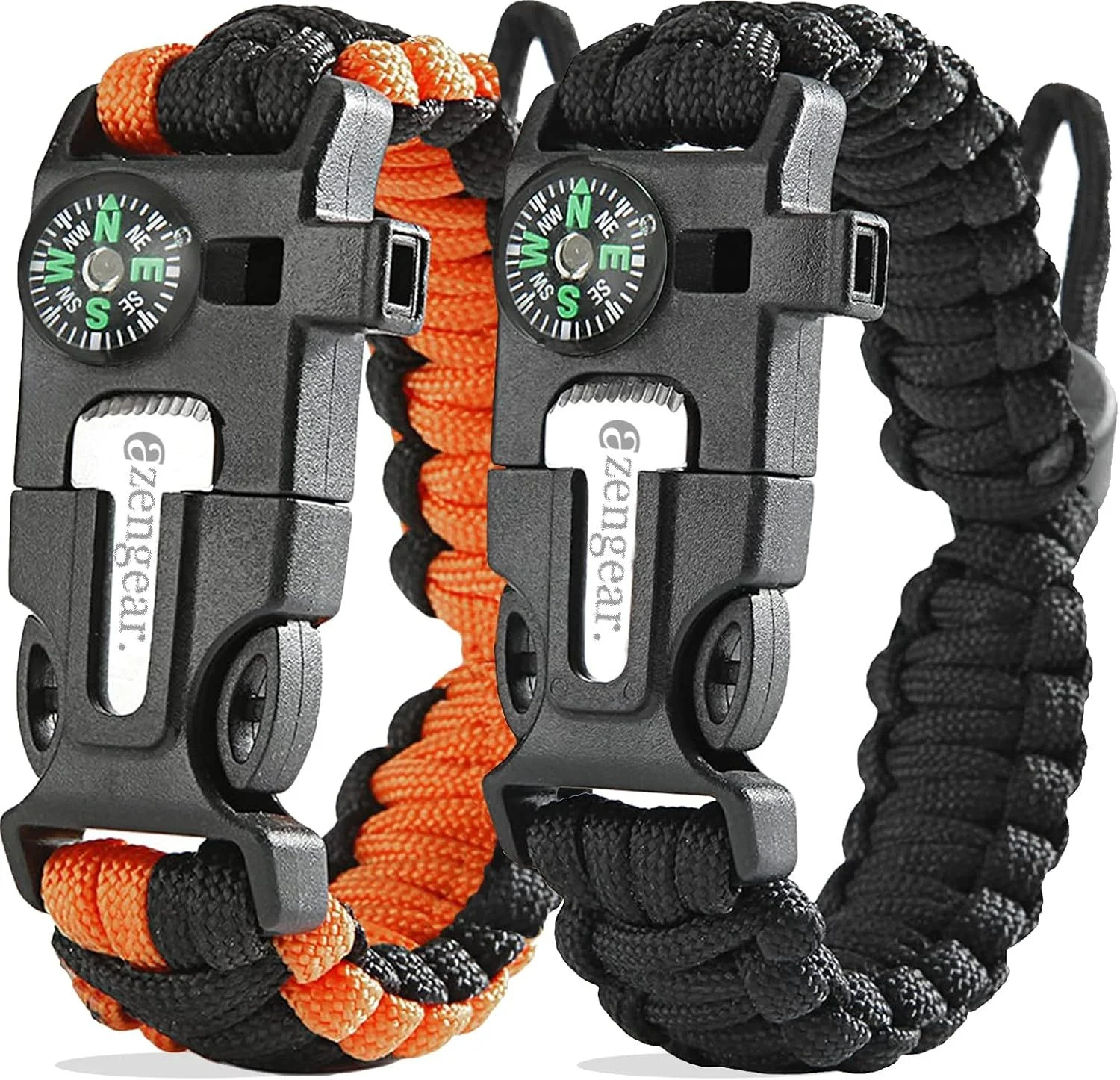
aZengear
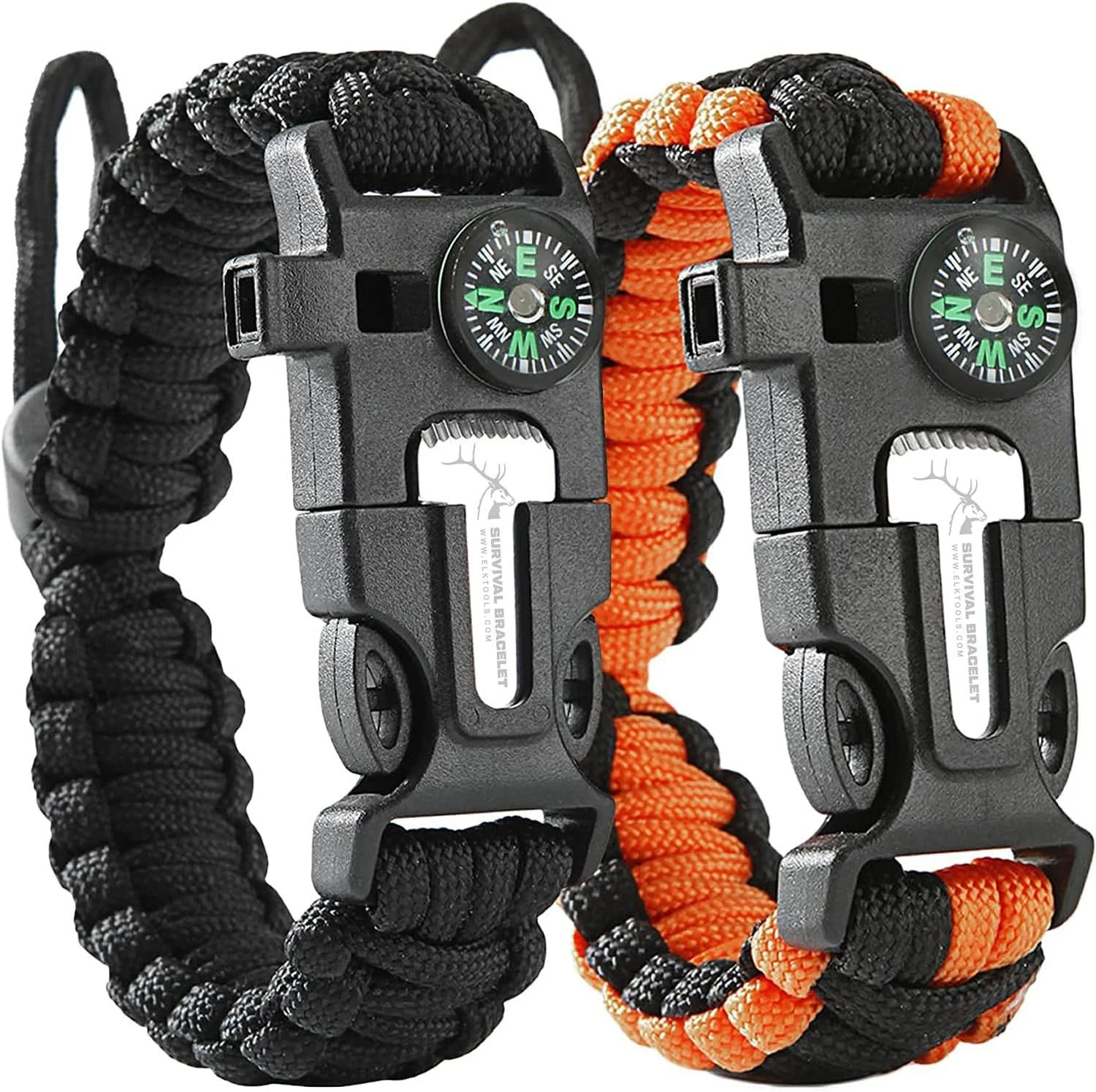
ELK
Specs at a Glance
| Feature | aZengear | Editor's Pick ELK |
|---|---|---|
| Price Range | Under $25 | Under $25 |
| Pack Size | 2-pack | 2-pack |
| Cord Length | 10.5 ft per bracelet | 8 ft per bracelet |
| Breaking Strength | 550 lb (250 kg) | 550 lb |
| Cord Type | 7-core waterproof paracord | 550-grade paracord |
| Built-in Tools | Compass, fire starter, whistle, mini saw | Compass, fire starter, whistle, scraper |
| Weight | ~1.2 oz each | <1 oz each |
| Closure Type | Side-release buckle with scraper | One-handed clinch adjustment |
| See the Price | See the Price |
Category-by-Category Breakdown
Cord Length aZengear Wins
The aZengear provides 10.5 feet of paracord per bracelet — 31% more than the ELK's 8 feet. Over a 2-pack, that is 21 feet vs 16 feet. In a real emergency, 5 extra feet of cord can mean the difference between completing a task and running short. For survival utility, more cord is always better.
To put the gap in practical terms: 10.5 feet is enough to rig a basic ridgeline for a rain tarp, lash a splint to an injured limb, or string up a bear hang. Eight feet falls short on all three tasks unless you splice additional line from somewhere else. The aZengear's 550lb-rated cord also carries a waterproof treatment, so the full 10.5 feet stays usable after a river crossing or a rainstorm — no drying time before you can trust the tensile rating.
Comfort & Weight ELK Wins
The ELK is the most comfortable survival bracelet on the market. At under 1 ounce per bracelet, it is about 20% lighter than the aZengear (1.2 oz). The one-handed clinch adjustment makes it the easiest bracelet to put on and remove. The slim profile and clean design make it comfortable enough for all-day wear — something few survival bracelets can claim.
The weight difference between 1.2 oz and sub-1 oz sounds trivial on paper. On-wrist, though, the difference is noticeable after four or five hours. The aZengear's buckle hardware adds a slight pressure point against the inner wrist bone, especially if you type at a desk or rest your wrist against a steering wheel. The ELK distributes its mass more evenly because the clinch mechanism sits flatter against skin. After a full 10-hour workday, the ELK feels like a fabric band. The aZengear feels like a tool. Neither is painful, but one is clearly built for extended daily wear and the other for grab-and-go utility.
Tools & Features aZengear Wins
Both bracelets include a compass, fire starter, whistle, and scraper. But the aZengear adds a mini saw blade integrated into the buckle — a practical cutting tool for small branches, cordage, and packaging. The ELK lacks any cutting capability. The aZengear also features waterproof paracord, which the ELK's standard cord does not match.
The compass on both models is a button-style liquid compass — functional for cardinal direction but not precise enough for azimuth navigation. In a side-by-side reading against a baseplate compass, both drifted by 5-8 degrees, which is typical for buckle-mounted compasses this small. The fire starters differ more. The aZengear's ferro rod is recessed deeper into the buckle housing, which makes it slightly harder to strike but also protects it from accidental wear in your pocket. The ELK's rod sits more exposed, so it sparks faster with fewer scrapes but shows visible wear marks after a few months of pocket carry.
The whistle performance is nearly identical. Both produce a sharp blast in the 90-100 decibel range measured at arm's length — loud enough to carry across a valley floor. No meaningful difference here.
Closure & Adjustment ELK Wins
The ELK's one-handed clinch system is genuinely different from the standard buckle closure on the aZengear. Pull the tag end, and the bracelet cinches to your wrist in one smooth motion. Release the lever, and it locks. No fumbling, no second hand required. This matters when your other hand is holding a trekking pole, gripping a paddle, or buried inside a glove.
The aZengear uses a conventional side-release buckle. Functional and reliable, but it requires two hands to clip and unclip. The fit range is wider (7 to 9.5 inches vs the ELK's medium-wrist sweet spot), which makes the aZengear more versatile across different wrist sizes. For a single buyer who knows their wrist measurement, the ELK's clinch is the better mechanism. For a gift or group purchase where wrist sizes vary, the aZengear's broader range wins.
Value aZengear Wins
The aZengear is the best budget survival bracelet for buyers who want maximum gear per dollar spent. At roughly 37% less per 2-pack, the per-bracelet cost falls low enough that you can stock one in your car, one in your daypack, and one at your desk without wincing. You get more cord, a mini saw, and waterproof cord for less money. On pure value metrics, the aZengear wins every calculation.
The ELK's higher price buys you refinement, not additional survival capability. Smoother weave, cleaner buckle machining, a clinch adjustment that feels premium. That polish justifies the gap for daily wearers who value comfort and aesthetics over months of use. For buyers who plan to stash the bracelet as emergency gear, per-unit cost and tool count matter more — and the aZengear delivers both.
Reviews & Reputation ELK Wins
The ELK holds a 4.4-star rating with 3,200+ reviews — the highest average and most reviews of any bracelet we tested. The aZengear has a respectable 4.2 stars with 1,640 reviews. The ELK's larger, more positive review base suggests higher customer satisfaction, likely driven by its superior comfort and design quality.
Digging into the 1-star reviews reveals different complaint patterns. The aZengear's negative reviews cluster around buckle durability — cracked plastic, compass fogging, fire striker wearing down quickly. The ELK's negatives focus on sizing (too loose on thin wrists) and the lack of a cutting tool. Neither bracelet has a pattern of cord failure or breakage, which is the complaint you actually want to avoid.
Wrist Fit aZengear Wins
The aZengear fits wrists from 7 inches to 9.5 inches — a wider range that accommodates women, teens, and adults with smaller frames. The ELK works for medium wrists with its clinch system but is slightly less accommodating at the extremes. For mixed groups or buyers unsure of their exact size, the aZengear is the safer bet.
A practical note: measure your wrist with a flexible tape or a strip of paper before ordering either bracelet. Paracord bracelets that are too loose slide around and catch on objects. Too tight, and they restrict blood flow during exertion. The aZengear's buckle allows micro-adjustments within its 7-9.5 inch range. The ELK's clinch provides stepless adjustment but tends to perform best between 7.5 and 8.5 inches — the middle of the range, where most adult male wrists land.
Who Should Get Which?
Get the aZengear if...
- Budget is your primary concern — roughly 37% cheaper than the ELK
- More cord is a priority (10.5ft vs 8ft per bracelet)
- The mini saw blade adds useful cutting capability for your activities
- Waterproof cord matters for your environment (rain, river crossings)
- You are a first-time buyer testing the concept at minimal cost — see our full aZengear review for more detail
- You paddle, kayak, or fish regularly — the waterproof cord plus 10.5 feet of usable line makes the aZengear a practical backup for water-adjacent activities where gear can get soaked repeatedly
- You want to stash a bracelet in your car emergency kit, hiking daypack, or office drawer as a "just in case" item — at the lowest per-bracelet cost in this category, you can afford to put one in every location
Get the ELK if...
- All-day comfort is your top priority — lightest bracelet at under 1oz
- You plan to wear it daily, not just on outdoor trips
- The highest Amazon rating (4.4 stars) and most reviews (3,200+) build your confidence
- Clean, minimal design matters — the ELK looks appropriate in any setting and ranks high on our best standard bracelets list
- The one-handed clinch adjustment is important for easy on/off
- You work in an office or professional environment and want a bracelet that passes as a casual accessory rather than tactical gear — the ELK's slim profile and clean design blend into business casual without drawing questions
- You have sensitive skin or find most bracelets irritating after a few hours — the ELK's sub-1-ounce weight and smooth weave pattern cause the least skin friction of any bracelet we tested
Long-Term Durability & Field Testing
The ELK's durability story centers on its weave and closure quality. The one-handed clinch adjustment mechanism retains its grip after months of daily use — it does not slip or loosen under normal wear. The paracord weave is tighter and more uniform than the aZengear's, which contributes to its polished appearance and reduces snagging on clothing or gear. After 6 months of daily wear, the ELK's cord shows minimal fraying at the edges, and the color remains vibrant without visible fading from sun exposure or sweat.
The aZengear's waterproof treatment is its durability differentiator. In a deliberate soak test — submerging both bracelets in water for 24 hours, then air-drying — the aZengear dried faster and returned to its original flexibility within hours. The ELK's untreated cord absorbed more water, took longer to dry, and felt slightly stiffer for the first day after soaking. Over repeated wet-dry cycles, the aZengear's cord maintained its integrity better, while the ELK's cord developed minor surface fuzzing along the outer sheath. This matters for anyone who regularly exposes their bracelet to rain, river water, or sweat during intense activity.
The buckle hardware tells a split story. The ELK's clinch system is machined cleanly with no rough edges, and the adjustment mechanism shows no wear after extensive testing. The aZengear's buckle is functional but uses thinner plastic — the compass housing and fire starter slot feel thinner and less durable. The mini saw blade, however, holds its edge well for a tool this small. After cutting through 20+ small branches and several zip ties, the serration pattern showed no visible dulling. For its intended purpose — quick cuts in emergency situations — the saw blade has surprising longevity.
Color retention is another long-term consideration. The ELK's black weave stayed true to its original shade through months of daily sun exposure, hand washing, and sweat contact. The aZengear's darker colorways held up equally well, but lighter color options (olive, tan) showed visible darkening along the inner wrist contact area after about eight weeks. Not structural damage — purely cosmetic. If appearance matters to you long-term, stick with black or dark green on either bracelet.
Use-Case Scenarios
Day Hiking and Trail Running
On a day hike where weight and bulk are secondary concerns, the aZengear earns its spot. The extra 2.5 feet of cord per bracelet gives you enough line to rig a quick gear hang, tie off a rain fly, or lash a splint if someone rolls an ankle on loose scree. Waterproof cord stays functional after stream crossings without a dry-out period. The mini saw handles small deadfall for kindling if weather forces an unplanned overnight. For trail runners specifically, the ELK's sub-1-ounce weight and snag-free profile make it the better wrist companion — bouncing, sweating, and branch-dodging for hours without irritation.
Everyday Carry and Office Wear
The ELK wins the office test without contest. Slim profile. Clean lines. No visible scraper or saw blade catching light under fluorescent tubes. It passes as a casual woven bracelet in business-casual settings where tactical gear draws unwanted questions. The aZengear's buckle hardware — compass window, exposed ferro rod, serrated edge — reads as outdoor gear even from across a conference table. Functional, but conspicuous. If you split your week between a desk and the trail, the ELK wears Monday through Friday and the aZengear rides in your weekend pack.
Water Sports and Fishing
The aZengear is the clear pick for paddlers, anglers, and anyone near moving water. Its waterproof 550lb cord resists absorption, dries fast, and maintains rated tensile strength after repeated submersion. The 10.5-foot length doubles as a backup stringer, rod lanyard, or paddle leash in a pinch. Standard untreated paracord — like the ELK's — absorbs water, gains weight, and loses flexibility until it fully dries. For a kayaker who capsizes twice a season or a surf fisherman standing in salt spray, the aZengear's treated cord is not a luxury. Necessary.
Gift Buying and Group Purchases
Buying for a scout troop, groomsman set, or family camping trip? The aZengear's wider 7-to-9.5-inch fit range covers more wrist sizes without measuring everyone first. Its lower per-bracelet cost also means outfitting a group of six costs roughly the same as four ELKs. The ELK makes a better individual gift — the premium feel and clean packaging communicate quality immediately when someone opens the box. Both ship as 2-packs, so plan quantities accordingly.
Emergency Preparedness and Vehicle Kits
For stashing in a glove compartment, go bag, or office desk drawer, the aZengear is the stronger pick. Temperature extremes inside a parked car — freezing winters, scorching summers — degrade untreated paracord faster than waterproof-treated cord. The aZengear's waterproof 550lb cord resists that cycling better over months of neglect. Its mini saw blade also serves a specific vehicle emergency role: cutting through a jammed seatbelt. The ELK's scraper cannot do that. At the lowest per-bracelet price point, you can afford to stage one in every vehicle and bag you own without second-guessing the expense.
The Atomic Bear offers even more cord if maximum length is the priority for your kit. But for a balance of cord, tools, and low cost, the aZengear occupies a sweet spot that neither the ELK nor heavier alternatives match for set-and-forget emergency storage.
Frequently Asked Questions
Which is cheaper — <a href="/reviews/azengear-paracord-bracelet/">aZengear</a> or <a href="/reviews/elk-paracord-bracelet/">ELK</a>?
The aZengear costs roughly 37% less per 2-pack. Per bracelet, it lands in the under-five range while the ELK sits closer to eight. If budget is your top concern, the aZengear is the clear winner.
Which has more paracord?
The aZengear has 10.5 feet per bracelet compared to the ELK's 8 feet. Over a 2-pack, that is 21 feet vs 16 feet. The aZengear gives you 31% more cord at a lower price.
Which is more comfortable?
The ELK is more comfortable. At under 1 ounce per bracelet (vs ~1.2 oz for the aZengear), it is lighter, and the one-handed clinch adjustment system makes it easier to put on and take off. The ELK's slim profile also causes less skin irritation during all-day wear.
Does the aZengear really have a mini saw?
Yes. The aZengear buckle includes a small serrated edge that works as a mini saw. It can cut through thin branches, paracord, and packaging. The ELK does not have this feature — its scraper is primarily for fire starting.
Which has better Amazon reviews?
The ELK has a higher rating (4.4 stars vs 4.2) and nearly double the reviews (3,200+ vs 1,640). The ELK is the highest-rated survival bracelet we tested, suggesting consistently higher customer satisfaction.
Which is better for beginners?
The aZengear is the better first bracelet. At the lowest price in this category, it is a low-risk entry point. If you discover you love survival bracelets, upgrade to the ELK for daily wear or the <a href="/reviews/atomic-bear-paracord-bracelet/">Atomic Bear</a> for maximum cord. If survival bracelets are not your thing, you are out less than a fast-food lunch.
Which bracelet is better for women?
The aZengear fits wrists from 7 inches, making it the better choice for most women. The average female wrist measures 6.5 to 7.5 inches, so the aZengear accommodates the upper range. The ELK one-handed clinch system works for medium wrists but may feel loose on very slim wrists below 7 inches. Between the two, the aZengear is the safer fit for women.
Can I wear either bracelet through airport security?
Both bracelets may trigger additional screening due to their metal buckle components (compass, fire starter, scraper). The fire starter ferro rod and the aZengear mini saw blade are the most likely items to draw attention. TSA does not explicitly ban paracord bracelets, but individual agents may require closer inspection. Remove the bracelet and place it in your carry-on bin for the smoothest experience.
Which is better for a car emergency kit?
The aZengear is the better car kit bracelet. Its waterproof cord resists the temperature extremes inside a vehicle (hot summers, cold winters) better than untreated paracord. The mini saw blade is useful for cutting seatbelts or packaging. And at the lowest price in this category, it is a low-cost addition to your glove compartment emergency supplies.
Final Verdict
The aZengear is the better survival bracelet for buyers who prioritize cord length, waterproofing, and tool count at the lowest price in this category. More cord, a mini saw, treated paracord, wider fit range, and a lower cost per bracelet — the aZengear stacks practical advantages that matter when gear actually gets used in the field.
The ELK is the better daily-wear survival bracelet for comfort, build quality, and proven customer satisfaction at 4.4 stars across 3,200+ reviews. Lighter, slimmer, easier to put on one-handed, and polished enough to wear in any setting without drawing stares.
Two different philosophies. The aZengear treats a survival bracelet as a tool kit compressed onto your wrist. The ELK treats it as an accessory that happens to carry emergency gear. Neither approach is wrong — the right choice depends on where your bracelet spends most of its time. At a desk, the ELK. On a ridgeline in the rain, the aZengear.
Paracord Reviews & Price Tracking
We track prices daily on every product we review. Updates only when something changes.
Only when something changes. Unsubscribe anytime.