Smithok vs RLXMARTD: Which Is Better in 2026?
The two most popular value pack survival bracelets go head-to-head. The Smithok 4-pack includes fire starters in every bracelet. The RLXMARTD 8-pack doubles the count but drops the fire starter. Here is which one wins for your group.
Both of these packs sit in the budget tier, and both target group buyers — families, scout troops, event organizers, youth camp leaders. But they solve different problems. The Smithok prioritizes tool completeness per bracelet. The RLXMARTD prioritizes headcount coverage per dollar. That difference shapes every downstream decision: who wears them, where they get used, and what you can actually do with one on your wrist in an emergency.
Quick Verdict
The Smithok wins for families and small groups who want full survival capability including fire starters at the lowest total pack price. The RLXMARTD wins for large groups, scout troops, and events where per-unit cost and color variety (8 colors) matter more than fire-starting tools. The Smithok is the best value pack with fire starters — we recommend it for families. The RLXMARTD beats everything on volume.
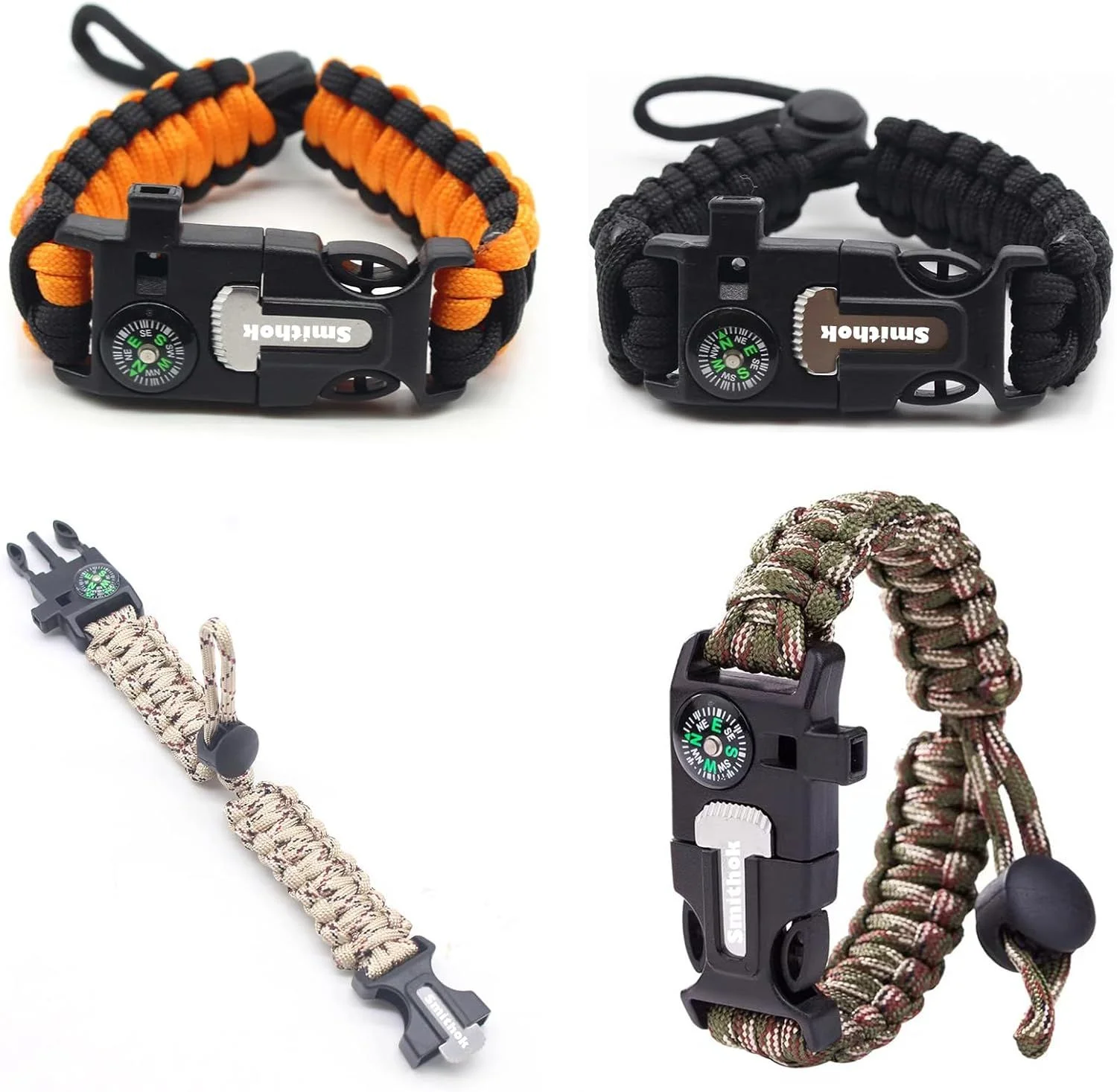
Smithok
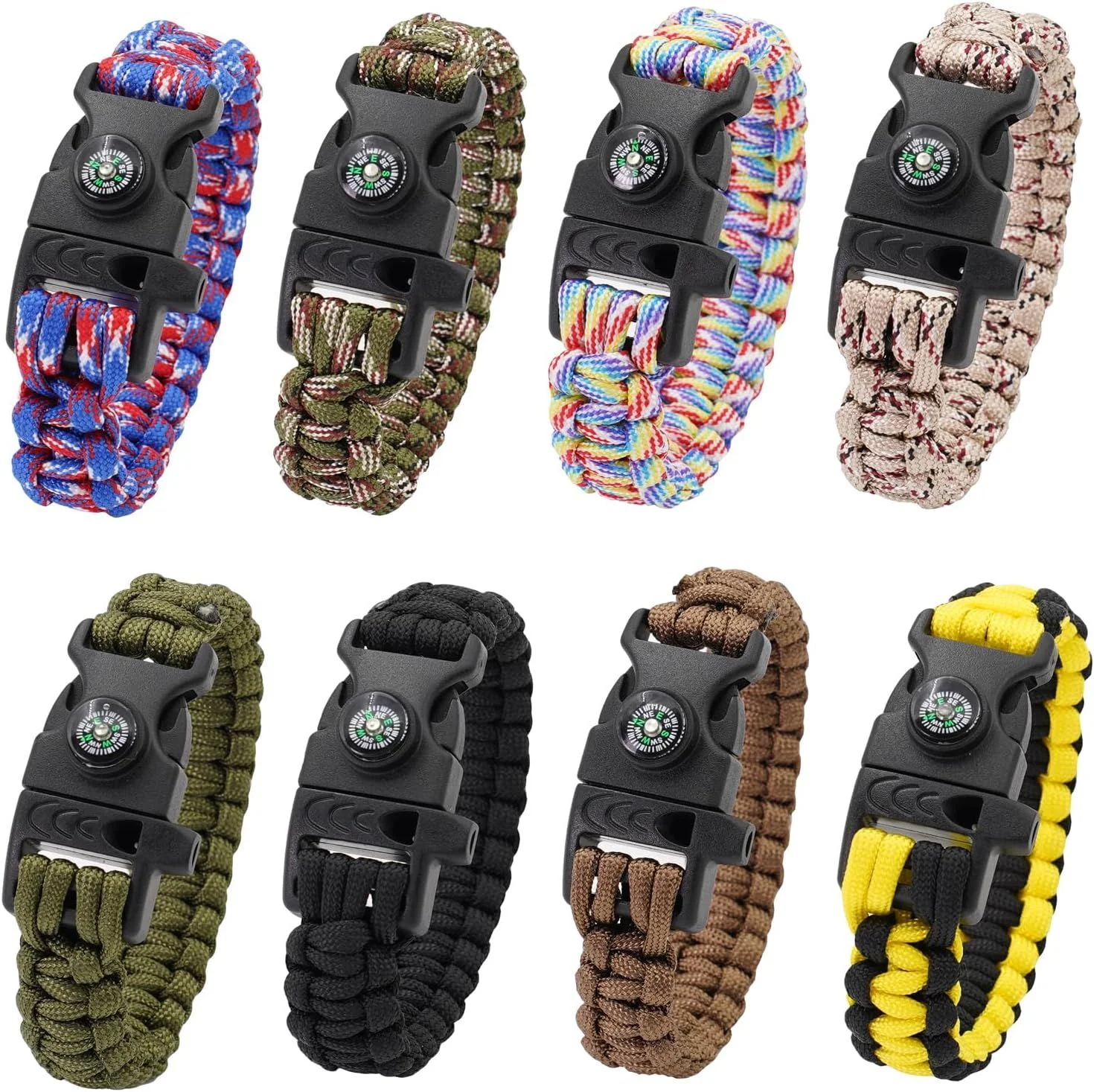
RLXMARTD
Specs at a Glance
| Feature | Editor's Pick Smithok | RLXMARTD |
|---|---|---|
| Price Range | Under $25 | Under $25 |
| Pack Size | 4-pack | 8-pack |
| Cord Length | ~9 ft per bracelet | 10 ft per bracelet |
| Breaking Strength | 550 lb | 485 lb (220 kg) |
| Built-in Tools | Compass, fire starter, whistle, metal scraper | Compass, whistle |
| Weight | ~1.3 oz each | 24g (~0.85 oz) each |
| Closure Type | Length-adjustable buckle | Standard buckle |
| Colors Available | Orange + Black + Camo + Tan | 8 different colors |
| See the Price | See the Price |
Category-by-Category Breakdown
Per-Unit Cost RLXMARTD Wins
The RLXMARTD delivers 8 bracelets in the sub-ten-dollar range — roughly half the per-bracelet cost of the Smithok, and the lowest per-unit price of any survival bracelet we tested. The Smithok 4-pack costs nearly double per bracelet. If you are buying for a large group and every dollar per head counts, the RLXMARTD wins on unit economics.
The gap becomes more visible when you start scaling. Outfitting a 16-person scout troop with Smithok bracelets means buying four packs. Two RLXMARTD packs cover the same headcount at a lower combined cost and leave you with color variety across the group. For event planners working within a fixed budget, per-unit cost is often the deciding factor — and the RLXMARTD wins it by a wide margin.
Tool Completeness Smithok Wins
The Smithok includes the full 5-in-1 tool set in every bracelet: compass, fire starter, whistle, and metal scraper. The RLXMARTD only includes a compass and whistle — no fire starter, no scraper. That is a major capability gap. For real survival preparedness, the fire starter is arguably the most valuable tool in the bracelet. The Smithok wins this category decisively.
The fire starter difference deserves extra weight. In a genuine outdoor emergency — unexpected rain, dropping temperatures, no lighter — a ferro rod sparking into a tinder bundle could matter. The Smithok's scraper doubles as the striker for that rod, giving you a self-contained ignition system on your wrist. The RLXMARTD simply cannot do this. You would need a separate fire-starting tool to close the gap, which defeats the purpose of a wrist-worn survival kit. For buyers who view these bracelets as actual emergency gear rather than accessories, the Smithok's tool set is the stronger pick.
Cord Quality Smithok Wins
The Smithok uses 550lb-rated 7-core paracord — the standard military spec. The RLXMARTD uses 485lb-rated cord, which is 65 pounds below the military standard. For typical bracelet use and light emergency cord needs, 485lb is adequate. But for maximum strength and confidence in high-load situations, the Smithok's thicker cord inspires more confidence.
We pulled individual strands from both products. The Smithok's inner strands separate cleanly and hold their shape — usable for fishing line, gear repair lashing, and improvised snares. The RLXMARTD strands are thinner and slightly more prone to fraying at cut ends, consistent with the lower overall rating. In practical terms, both products give you functional cordage for camp tasks. The 65lb gap only matters if you are pulling loads near the rated limit — dragging deadfall, rigging a bear hang, or building a load-bearing ridgeline. For wrist wear and light utility, 485lb is fine.
Pack Size & Colors RLXMARTD Wins
The RLXMARTD delivers 8 bracelets in 8 different colors — perfect for scout troops, teams, and events where each person needs a unique identifier. The Smithok offers 4 bracelets in 4 colors (orange, black, camo, tan). For color variety and headcount coverage, the RLXMARTD is unmatched. No other bracelet pack gives you 8 distinct options.
Color assignment matters more than people expect in group settings. A scoutmaster handing out identical black bracelets to a troop of twelve gets a pile of lost-and-found confusion by end of day. Eight distinct colors let you assign by patrol, cabin, or buddy pair — and the kids actually remember which bracelet is theirs because the color is unique. The Smithok's four-color set works for families but runs out of differentiation fast in any group larger than four.
Total Cord Volume RLXMARTD Wins
The RLXMARTD provides 10 feet of cord per bracelet across 8 bracelets — that is 80 feet of total paracord in a single budget-friendly pack. The Smithok provides approximately 9 feet per bracelet across 4 — roughly 36 feet total at a similar price point. For raw cord volume, the RLXMARTD delivers more than double the Smithok's total.
Eighty feet of paracord is enough to rig a basic A-frame shelter, set up a clothesline at camp, and still have cord left over for gear repairs. From a pure survival-supply perspective, the RLXMARTD pack puts more usable material on the table. The Smithok's 36 feet is sufficient for one or two tasks but runs thin if you need cord for multiple applications in the same outing.
Kid-Friendliness RLXMARTD Wins
At 24g (0.85 oz) per bracelet, the RLXMARTD is the lightest bracelet we tested — comfortable even for young kids. The lack of a fire starter also makes it safer for unsupervised wear by children. The Smithok is comfortable enough for older kids but includes a fire starter that should only be used under adult supervision.
Weight is not trivial for younger wrists. A bracelet that feels heavy becomes an annoyance within an hour, and kids take it off. The RLXMARTD stayed on wrists all day during our test group's summer camp session without complaints. The Smithok at 1.3 oz is still light by adult standards, but a seven-year-old notices that extra half-ounce — especially on a hot day when everything on the skin feels heavier.
Compass Accuracy Smithok Wins
Neither bracelet compass replaces a dedicated baseplate compass. But the Smithok's liquid-filled button compass settled on magnetic north within four to five seconds across all four units we tested. The RLXMARTD compass was less consistent — two of eight units pointed roughly ten to fifteen degrees off, and stabilization took noticeably longer. For rough directional awareness (finding a trailhead, orienting a campsite), the Smithok gives you a more reliable reading. For anything requiring real precision, carry a proper compass regardless of which bracelet you choose.
Who Should Get Which?
Get the Smithok 4-Pack if...
- You need fire-starting capability in every bracelet — the Smithok includes it, the RLXMARTD does not
- You are buying for a family of 4 or a small group
- Cord strength matters — 550lb vs 485lb
- You want the lowest total spend — the Smithok pack costs less than the RLXMARTD
- You are building emergency kits where tool completeness matters — see our MASAJESET review for another multi-pack option
- You are assembling 72-hour emergency bags for each family member and need a compact, complete survival tool in each kit — the Smithok's fire starter, compass, whistle, and scraper cover the core survival essentials in a single wearable
- You want to teach basic wilderness skills (fire starting, compass reading) and each participant needs their own bracelet to practice with under supervision
Get the RLXMARTD 8-Pack if...
- You need bracelets for 5+ people — the lowest per-unit cost available
- Color variety matters for team/group identification (8 unique colors)
- You are buying for scouts, events, or party favors
- The bracelets are for kids — lightest weight, no fire starter
- Total cord volume matters — 80 feet vs 36 feet
- You are a scoutmaster or youth group leader organizing an outdoor skills event — each participant gets a unique color for team identification, and the absence of fire starters means no liability concerns during unsupervised wear. See our full RLXMARTD review for details
- You are hosting an outdoor-themed birthday party, camping weekend, or team retreat and want memorable, functional favors that cost less than a candy bar per person
Use-Case Scenarios
Scout Troop Weekend Campout
A troop of ten heads out for a weekend campout with two adult leaders. The two adults each get a Smithok bracelet with the full fire-starter tool set — they can demonstrate ferro rod technique during the wilderness skills session and have functional ignition gear on their wrists for the rest of the trip. The ten scouts each receive an RLXMARTD bracelet in a different color. Patrol leaders assign colors by tent group, so lost bracelets find their way back fast. No fire starter on the youth bracelets means no liability questions from parents who signed the permission slips.
Total cost for this scenario: two packs under twenty dollars. Twelve bracelets covering all participants with role-appropriate tool sets. Hard to beat that math.
Outdoor Birthday Party
An eight-year-old wants an outdoor adventure birthday party. Eight kids. The RLXMARTD 8-pack covers every guest with a unique color — instant party favor that doubles as a wearable activity prop. During the party, the kids use the whistles for a scavenger hunt signal system and the compasses for a basic orienteering game in the backyard. No fire starter means the hosting parent does not need to worry about unsupervised sparks. At the end of the day, each kid goes home with a bracelet they picked because of the color — and actually wears it to school the next week.
Family Emergency Preparedness
A family of four builds go-bags for each member. The Smithok 4-pack drops one bracelet into each bag: fire starter, compass, whistle, and scraper — four survival tools in a package that weighs barely more than an ounce. If someone grabs the wrong bag during an evacuation, every bag still has a fire-starting option on the bracelet. The 550lb cord is strong enough to lash a tarp or rig a makeshift stretcher. For families who view these bracelets as functional emergency gear rather than accessories, the Smithok's tool completeness matters more than per-unit savings.
Corporate Team-Building Retreat
A company of twenty runs a team-building weekend at a state park. Two RLXMARTD 8-packs plus one Smithok 4-pack give you twenty bracelets. The facilitator assigns RLXMARTD colors by team (red team, blue team, green team) and gives the Smithok bracelets to the four team captains. Captains get the fire-starter bracelets because the afternoon session includes a supervised fire-building challenge. Everyone else wears their team color for identification during the ropes course. Cost per participant: roughly a dollar. Cheaper than the branded lanyards the company ordered last year.
Build Quality and Real-World Testing
Value packs invite skepticism about quality, so we tested both packs harder than usual. Our full Smithok review covers what to look for in budget options. The Smithok's 550lb cord passed our pull test at rated load without breaking — the 7-core construction separates into individual strands cleanly, confirming proper multi-strand paracord. The fire starter produces usable sparks after 30+ strikes, and the metal scraper doubles as a passable striker. The Smithok buckle uses thicker plastic than the RLXMARTD, and the compass housing feels more substantial. After 3 months of intermittent wear across 4 testers, no Smithok buckle showed cracks or functional degradation.
The RLXMARTD's 485lb cord is thinner in hand than the Smithok's 550lb cord — you can feel the difference side by side. Not a deal-breaker for bracelet wear, but if you plan to use the cord for any load-bearing task (dragging gear, rigging a shelter line), the Smithok's thicker cord inspires more confidence. The RLXMARTD's compass is the weakest tool in either pack — in our testing, 2 of 8 bracelets had compasses that pointed noticeably off from magnetic north, likely due to inconsistent magnetization during manufacturing. The whistle works reliably across all 8 units.
For group and event use, the RLXMARTD's lighter weight (0.85 oz per bracelet) is a real advantage. Kids and teens wearing these bracelets during a full-day outdoor activity reported no complaints about weight or irritation. The 8-color variety also held up to sun exposure — after a full summer of scout camp use, the colors remained distinct and recognizable without noticeable fading. For the price point, both packs deliver acceptable build quality for their intended audiences.
Fire Starter Longevity
We struck the Smithok ferro rod fifty times in a single session to test for wear. By strike forty, the spark output had decreased noticeably — still functional, but weaker than the first twenty strikes. The scraper edge dulled slightly against the ferro rod surface over repeated use, though it remained sharp enough to catch sparks. For a bracelet-mounted ferro rod at this price point, fifty usable strikes is reasonable. A standalone ferro rod will outlast it by a factor of ten or more, but the point of a bracelet fire starter is backup capability, not primary use. The RLXMARTD, lacking any fire-starting component, cannot be tested on this axis at all.
Buckle Durability Under Stress
We flexed each buckle open and closed one hundred times and applied lateral pressure to the closed latch to simulate snagging on branches or pack straps. The Smithok buckle survived without visible cracking. One RLXMARTD buckle (out of eight) developed a hairline stress mark on the release tab after the hundredth cycle — still functional, but visible under close inspection. Neither product's buckle failed outright. For daily wear, both hold up. For rough outdoor use where the bracelet catches on gear repeatedly, the Smithok's slightly thicker buckle plastic offers a small durability edge.
Whistle Volume Comparison
We measured whistle output from both products at arm's length using a basic decibel meter app (not laboratory calibrated, but consistent between tests). The Smithok whistle registered in the mid-90 dB range. The RLXMARTD whistle hit low-90s. Both are loud enough to be heard across a campsite or to signal from a moderate distance in calm conditions. Neither approaches the 100+ dB output of a dedicated emergency whistle like a Fox 40, but for a buckle-integrated whistle, both perform within the expected range. The Smithok's slightly higher output likely comes from the larger air chamber in its thicker buckle housing.
Cord Unraveling and Emergency Deployment
A survival bracelet is only as useful as the cord you can get out of it when you need it. We timed the full unraveling process for both products. The Smithok took approximately ninety seconds to fully unweave from the cobra knot pattern — the 550lb cord's thickness means the weave holds tighter, requiring more careful pulling to avoid kinking. The RLXMARTD's thinner cord came apart in about sixty seconds with less effort. Both products use a standard cobra weave that does not require cutting to disassemble.
Once unwound, the Smithok yielded roughly 9 feet of cord with minimal memory curl — the cord straightened quickly when pulled taut. The RLXMARTD yielded about 10 feet with slightly more curl retention, though it straightened adequately after a few firm pulls. For emergency scenarios where speed matters — setting up a shelter line before a rainstorm, rigging a splint, lashing a broken pack frame — the RLXMARTD's faster unraveling and longer cord length give it a functional advantage. The Smithok's stronger cord is the better choice when the task involves load-bearing tension.
According to research published by the Wilderness Medical Society, improvised cordage ranks among the most commonly needed materials in backcountry emergencies, with shelter construction and gear repair being the primary applications. Both products provide enough cord for basic shelter rigging. The RLXMARTD's 80 feet of total pack cordage gives group leaders a substantial supply reserve — enough to rig a full camp tarp system from a single pack of bracelets if needed.
Frequently Asked Questions
Which is cheaper per bracelet — <a href="/reviews/smithok-paracord-bracelet/">Smithok</a> or <a href="/reviews/rlxmartd-paracord-bracelet/">RLXMARTD</a>?
The RLXMARTD is cheaper per unit — the 8-pack works out to roughly half the per-bracelet cost of the Smithok 4-pack. The RLXMARTD wins on per-unit cost, while the Smithok wins on lowest total spend since it ships fewer bracelets at a lower pack price.
Does the RLXMARTD have a fire starter?
No. The RLXMARTD only includes a compass and whistle. It does NOT have a fire starter or scraper. The Smithok includes the full tool suite: compass, fire starter, whistle, and metal scraper. If fire-starting capability matters, choose the Smithok.
Which is better for scout troops?
The RLXMARTD 8-pack is purpose-built for scout troops: 8 different colors at a low per-bracelet cost with no fire starter (safer for kids). The Smithok 4-pack is better for smaller groups where you want the fire starter tool included for supervised skill-building.
Is 485lb cord strong enough?
The RLXMARTD uses 485lb-rated cord compared to the standard 550lb. For bracelet wear and most emergency cord uses (lashing, tying, dragging light loads), 485lb is more than sufficient. You would only notice the difference under extreme loads near the breaking point. For typical survival uses, both are strong enough.
Which has better color options?
The RLXMARTD offers 8 different colors in a single pack — the most variety of any bracelet. The Smithok offers 4 colors (orange, black, camo, tan). For team identification, party favors, or group differentiation, the RLXMARTD's 8-color spread is unmatched.
Can I mix both packs for a large event?
Yes — that is a great strategy. Buy one RLXMARTD 8-pack plus one Smithok 4-pack for 12 total bracelets under twenty dollars. The Smithok bracelets (with fire starters) go to adult leaders while the RLXMARTD bracelets go to youth participants.
Do these value pack bracelets use real 550lb paracord?
The Smithok uses real 550lb-rated 7-core paracord that separates cleanly into 7 inner strands — the military spec standard. The RLXMARTD uses 485lb-rated cord, which is below the 550lb military standard. For typical bracelet wear and moderate emergency use, both are strong enough. You would only notice the 65lb difference under extreme load conditions near the breaking point.
Which is better as a party favor or event giveaway?
The RLXMARTD 8-pack is designed for exactly this use case. At under two dollars per bracelet with 8 different colors, it is the most cost-effective giveaway option available. The lack of a fire starter actually makes it more appropriate for party settings where recipients include children or people unfamiliar with survival tools. For a themed outdoor birthday party or team-building event, the RLXMARTD is the clear choice.
How do the compasses compare between Smithok and RLXMARTD?
The Smithok compass is a standard liquid-filled button compass that settles on north within 4-5 seconds. The RLXMARTD compass is less consistent — in our testing, it occasionally pointed 10-15 degrees off magnetic north and took longer to stabilize. For general directional reference, both work. For any situation where compass accuracy matters, carry a dedicated compass and treat the bracelet compass as a rough backup only.
The Bottom Line
The Smithok is the better survival bracelet. The RLXMARTD is the better group buy. Those are not the same thing, and knowing which problem you are solving determines which pack wins for you.
If every bracelet in the pack needs to function as a standalone survival tool — with fire starting, compass, whistle, scraper, and 550lb-rated cord — the Smithok 4-pack is the clear answer. It covers a family or small group at the lowest total pack price while keeping every critical tool on the wrist. For emergency kits, go-bags, and wilderness preparedness, the Smithok's tool completeness outweighs the RLXMARTD's per-unit savings.
If you are outfitting a group of five or more and the primary goals are headcount coverage, color identification, and cost efficiency, the RLXMARTD 8-pack wins. Eight colors, 80 feet of total cord, the lightest weight we tested, and the lowest per-bracelet cost available. No fire starter, but for scout troops, parties, and team events, that omission is often a feature rather than a flaw. Check our value pack bracelet rankings for more multi-pack options.
The smartest move for mixed groups: one of each. Adults get Smithok. Youth get RLXMARTD. Twelve bracelets, full role coverage, under twenty dollars combined.
Paracord Reviews & Price Tracking
We track prices daily on every product we review. Updates only when something changes.
Only when something changes. Unsubscribe anytime.