History of Paracord: WWII to Survival Gear
Paracord — short for parachute cord — started as a military invention designed to keep paratroopers alive during World War II. Within a decade, soldiers had repurposed it for everything from bootlaces to shelter building. By the 2010s, it had evolved from military surplus into a global survival gear phenomenon worn on millions of wrists.
This is the story of how a simple nylon cord became the most versatile material in outdoor and survival culture — and why the 550lb rating on your bracelet traces back to specifications written over 80 years ago.
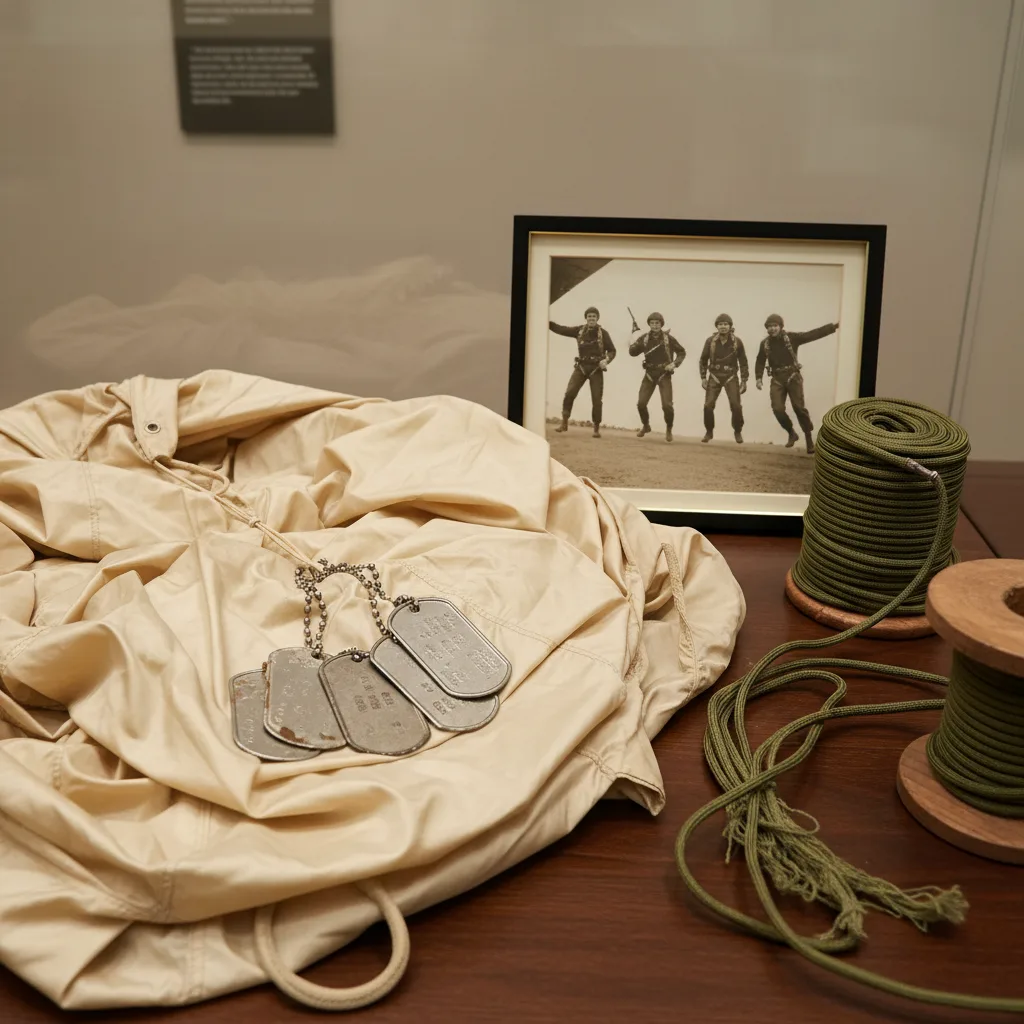
World War II Origins: The Birth of Paracord
Paracord was born out of necessity in the early 1940s when the U.S. military needed a reliable suspension line for its T-5 parachute system. The cord had to be lightweight enough to pack efficiently, strong enough to support a fully loaded paratrooper (200+ pounds of soldier plus equipment), and flexible enough to deploy consistently from a packed chute at terminal velocity.
The solution was a kernmantle construction — a woven nylon outer sheath surrounding multiple inner strands. Nylon itself was a recent invention by DuPont (patented in 1938), and its combination of elasticity, strength, and mildew resistance made it the ideal material. The military designated the cord under specification MIL-C-5040, with Type III (550lb minimum breaking strength) becoming the standard for personnel parachutes.
During the war, paratroopers from the 82nd and 101st Airborne Divisions — the units that jumped into Normandy on D-Day — carried hundreds of feet of paracord packed into their chutes. After landing, resourceful soldiers quickly discovered that the cord they had just trusted with their lives was equally useful on the ground.
Military Adoption: From Parachutes to Everything
By the Korean War (1950-1953), paracord had transcended its original purpose. Soldiers used it for so many improvised tasks that surplus paracord became one of the most requested supply items. The military had inadvertently created the most versatile utility cord ever manufactured.
Vietnam War: The Golden Age of Field Improvisation
Vietnam-era troops elevated paracord improvisation to an art form. Operating in dense jungle with limited resupply, soldiers found dozens of uses that the cord's designers never anticipated:
- Bootlace replacement — inner strands threaded through eyelets lasted longer than standard-issue laces in tropical conditions
- Equipment lashing — securing gear to packs, trees, and vehicles with knots that held under vibration and rain
- Perimeter tripwires — strung at ankle height around camp positions, sometimes attached to flares or noise-makers
- Improvised belts and slings — replacing worn or damaged web gear in the field
- Tent and poncho rigging — building overhead cover using available trees and paracord ridgelines
- Field sutures — individual inner strands used by medics when proper suture material was unavailable
- Fishing line — inner strands pulled from the sheath and used to supplement rations
Post-Vietnam Through the Gulf War
As the military standardized more of its equipment, paracord was formally written into field manuals as a general-purpose utility cord. The specification was updated to MIL-C-5040H (later redesignated MIL-DTL-5040), which codified the Type I through Type IV classifications that are still used today. By Desert Storm in 1991, every branch of the military included paracord in standard equipment loadouts, and the cord was a staple of military surplus stores.
Civilian Adoption: The 1990s and 2000s
Paracord entered civilian hands primarily through military surplus sales in the 1990s. Veterans who had relied on it overseas continued using it at home, and their recommendations spread through hunting camps, fishing lodges, and early outdoor forums on the internet.
Three communities drove civilian adoption:
The Outdoor Recreation Community
Hikers, campers, and climbers discovered what soldiers already knew — paracord was lighter, stronger, and more versatile than cotton rope or twine. By the late 1990s, outdoor retailers like REI and Cabela's stocked bulk paracord alongside their rope and cordage sections. The cord became standard in serious backpacking kits.
The Survival and Prepper Movement
As the survivalist community grew through the 2000s, paracord became a cornerstone of emergency preparedness kits. Survival instructors taught students to carry 50-100 feet of 550 cord at all times. The logic was compelling: at roughly 4 grams per foot, 50 feet of paracord weighs less than half a pound but provides enough material to build a shelter, set snares, create a fishing kit, or rig a rescue harness.
The DIY and Crafting Community
The mid-2000s saw an explosion of paracord crafting. Online tutorials taught people to weave everything from dog collars to rifle slings to keychains. The cobra weave — the pattern used in most survival bracelets — became the signature technique, prized because it packs the maximum amount of cord into a compact, wearable format.
The MIL-C-5040H Specification
The military specification that governs paracord (originally MIL-C-5040, now MIL-DTL-5040) defines six types of nylon cordage. Understanding this specification is essential for distinguishing genuine military-grade paracord from the commercial imitations that flooded the market during the bracelet boom.
| Type | Min. Strength | Inner Strands | Primary Use |
|---|---|---|---|
| Type I | 95 lb | 1 | Small equipment lashing |
| Type II | 400 lb | 4-7 | General utility |
| Type III (550) | 550 lb | 7-9 | Parachute suspension lines |
| Type IV | 750 lb | 11 | Heavy-duty military use |
Type III — the 550lb variant — became synonymous with "paracord" in civilian use because it offered the best balance of strength, diameter (approximately 4mm), and flexibility. It is thick enough to grip comfortably yet thin enough to weave into bracelets and lanyards.
The Survival Bracelet Boom: 2010s to Today
The paracord survival bracelet emerged around 2008-2010 as a way to carry a useful length of cord on your wrist at all times. Early versions were simple cobra-weave bands — no tools, just 8-12 feet of cord that could be unraveled in an emergency. The appeal was immediate: wearable survival gear that looked like a rugged fashion accessory.
Several factors converged to create a commercial boom:
- YouTube tutorials — DIY bracelet-making videos went viral, with some accumulating millions of views
- Military appreciation culture — bracelets became popular as "support the troops" accessories, especially in patriotic color schemes
- Prepper community growth — post-2008 recession survivalism drove demand for compact, affordable emergency gear
- Amazon marketplace expansion — Chinese manufacturers produced survival bracelets at scale, driving prices below $5 per unit
- Tool integration — manufacturers began embedding compasses, fire starters, whistles, and scrapers into buckle assemblies, transforming simple cord bracelets into multi-tool survival kits
By 2015, the market had matured into distinct segments. Budget value packs like the RLXMARTD 8-pack ($1.25 per bracelet) competed with premium options like the NexfinityOne ($25.99 for a 2-pack with SOS LED). The Atomic Bear carved out the enthusiast middle ground with 12 feet of genuine 550lb cord and a reliable fire starter at $12.99 for two.
Paracord Today: A Material With No Ceiling
Modern paracord has evolved far beyond its WWII roots. Today's market includes reflective cord for nighttime visibility, glow-in-the-dark variants for cave and night use, and fire-resistant versions treated with flame-retardant coatings. The aZengear uses waterproof-rated paracord that resists moisture absorption — a direct improvement over the original military nylon that soaked up water and took hours to dry.
The survival bracelet market continues to innovate. LED-equipped models like the NVioAsport 20-in-1 pack thermometers, multi-tool cards, and SOS strobes into a wrist-worn package that would have seemed absurd to a WWII paratrooper. Yet the core material — a nylon sheath over inner strands, rated to 550 pounds — remains essentially the same specification that the military wrote eight decades ago.
That durability of design is what makes paracord remarkable. The basic engineering was right from the start. Everything since has been refinement, not reinvention.
Frequently Asked Questions
When was paracord invented?
Paracord was developed in the early 1940s for use as parachute suspension lines during World War II. The United States military needed a lightweight, strong cord that could reliably support a paratrooper's weight during descent, and nylon — a newly invented synthetic material — proved ideal for the job.
Why is it called 550 paracord?
The "550" refers to the minimum breaking strength of 550 pounds. This is the specification for Type III paracord under the military standard MIL-C-5040H (later MIL-DTL-5040). Type III became the most common variant because its strength-to-weight ratio suited the broadest range of military and civilian applications.
Did soldiers really use paracord for everything in Vietnam?
Yes. Vietnam-era soldiers are well documented using paracord for bootlace replacement, equipment lashing, improvised belts, tent repair, securing perimeters with tripwires, and even suturing wounds in field emergencies. The cord was so universally useful that troops would salvage it from damaged parachutes and hoard extra lengths.
What is MIL-C-5040H?
MIL-C-5040H (now MIL-DTL-5040) is the U.S. military specification that defines paracord construction, materials, and performance standards. It specifies nylon construction, minimum breaking strengths for each type (I through IV), inner strand count, elongation limits, and environmental resistance requirements. Cord meeting this spec is considered "mil-spec" paracord.
When did paracord bracelets become popular?
Paracord bracelets gained mainstream popularity around 2010-2012, driven by the survival and prepper communities, YouTube tutorials, and military appreciation trends. The concept existed in niche outdoor circles since the early 2000s, but the combination of social media, Etsy crafters, and the broader survival gear trend pushed them into mainstream retail by 2013.
Is modern paracord the same as WWII paracord?
The core concept is the same — a nylon sheath over multiple inner strands — but modern manufacturing has improved significantly. Today's mil-spec 550 paracord uses higher-quality nylon 6 and nylon 6.6, has more consistent strand construction, and undergoes stricter quality testing. Commercial (non-mil-spec) paracord varies widely in quality and may use different materials entirely.
How much paracord is in a survival bracelet?
A standard survival bracelet contains 8 to 12 feet of paracord, depending on the weave pattern, bracelet length, and cord thickness. The cobra weave — the most common bracelet pattern — uses approximately 1 foot of cord per inch of bracelet length. A 9-inch bracelet in cobra weave contains roughly 9-10 feet of usable cord.
From Battlefields to Bracelets
Paracord's journey from WWII parachute lines to wrist-worn survival kits is a story of practical engineering meeting human ingenuity. Soldiers turned suspension cord into a universal field tool. Civilians turned military surplus into a crafting and survival phenomenon. And manufacturers turned a simple nylon cord into a multi-billion-unit market.
The next time you strap on a survival bracelet, you are wearing a direct descendant of the cord that dropped paratroopers into Normandy — the same basic material, the same 550lb specification, and the same versatility that made it indispensable on every battlefield since 1942.
Ready to choose a bracelet that carries on that legacy? Read our complete buying guide or browse our top-rated standard survival bracelets.