Types of Paracord: 550, 750, Micro & More
Not all paracord is created equal. The "550 paracord" label on most survival bracelets refers to one specific type out of six military classifications — each with different strength ratings, inner strand counts, and intended applications. Understanding these types is the difference between carrying reliable survival cord and wearing a decorative accessory that fails under real load.
This guide breaks down every paracord type from micro cord to Type IV, explains the critical difference between mil-spec and commercial cord, and clarifies exactly what is (and is not) wrapped around your wrist.
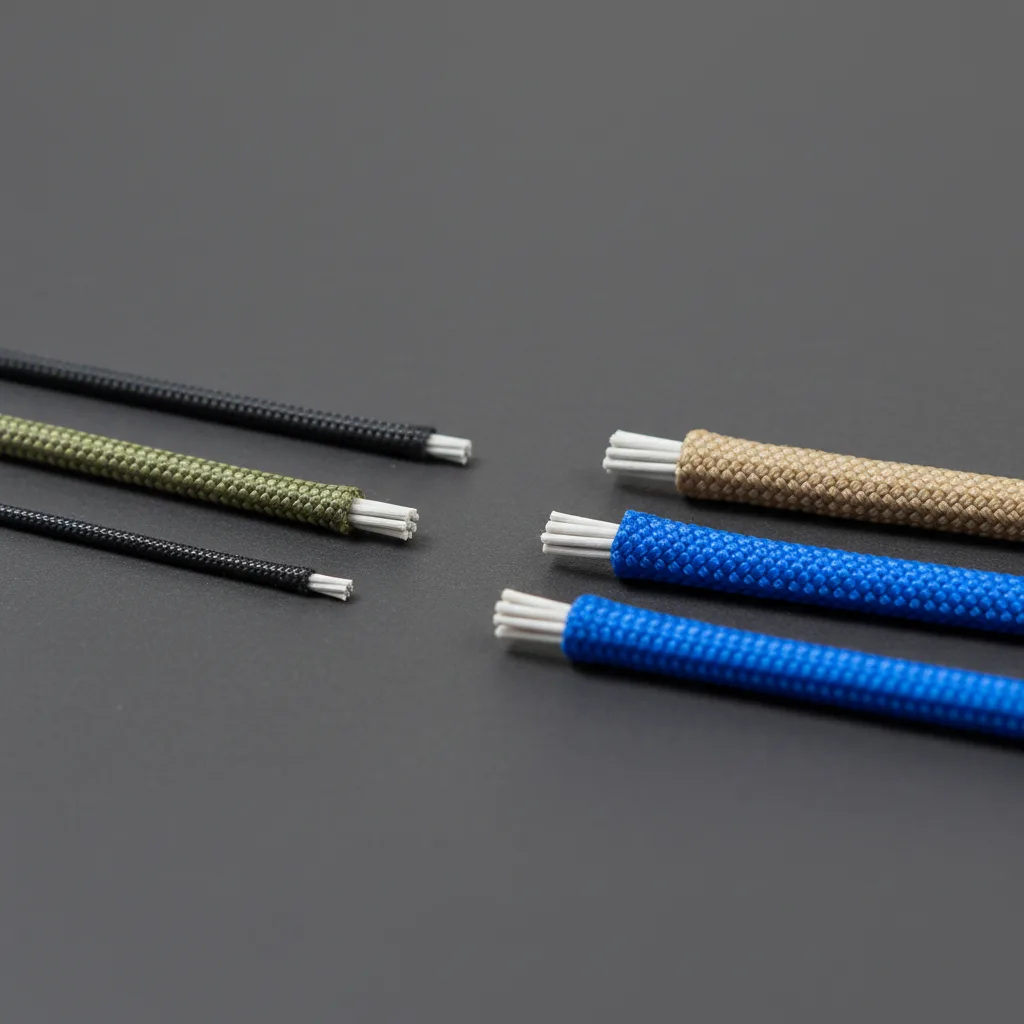
The Military Classification System
Paracord types are defined by the U.S. military specification MIL-DTL-5040 (originally MIL-C-5040H). Each type specifies a minimum breaking strength, inner strand count, and construction standard. Here is the complete breakdown:
Type I — 95lb (Micro Utility Cord)
Type I is the thinnest military-rated paracord at approximately 1.85mm diameter. It contains a single inner strand inside a thin woven sheath and is rated to 95 pounds of breaking strength. The military uses it for small equipment lashing, cord locks, and situations where minimal bulk matters more than high strength.
Survival bracelet use: Rare. Type I is too weak for functional survival applications. You occasionally see it in decorative accent braids or as an inner cord within more complex bracelet designs, but it should never be your primary survival cord.
Type II — 400lb (Light Duty)
Type II paracord has 4 to 7 inner strands with a breaking strength of 400 pounds and a diameter of approximately 3mm. It was originally designed for lightweight utility and equipment lashing applications where Type III was unnecessarily heavy.
Survival bracelet use: Uncommon. Some thinner "tactical" bracelets use Type II for a slimmer profile, but most manufacturers opt for Type III because the small increase in diameter delivers substantially more strength. If a bracelet advertises "400lb cord," it is likely Type II.
Type III — 550lb (The Standard)
Type III is the paracord. When someone says "paracord" without qualification, they mean Type III 550. It has 7 inner strands (each made of 3 twisted yarns), a 32-strand woven nylon sheath, a diameter of approximately 4mm, and a minimum breaking strength of 550 pounds.
This is what paratroopers used as parachute suspension lines. This is what soldiers improvised with in Vietnam. And this is what sits on your wrist when you buy a quality survival bracelet.
Survival bracelet use: This is the industry standard. The Atomic Bear, aZengear, and virtually every bracelet we review uses Type III 550 cord. The 4mm diameter is thick enough to grip comfortably in your hands but thin enough to weave into a compact bracelet.
Type IV — 750lb (Heavy Duty)
Type IV has 11 inner strands and a minimum breaking strength of 750 pounds. The diameter increases to approximately 6mm — noticeably thicker than Type III. The military uses it for heavy equipment rigging, cargo suspension, and applications where maximum strength is required.
Survival bracelet use: Very rare. The 6mm diameter makes it uncomfortable for bracelet weaving and daily wear. The finished bracelet is significantly bulkier and stiffer than a Type III version. Unless you specifically need 750lb cord strength (and for wrist-worn survival gear, you almost never do), Type III is the better choice.
Non-Military Paracord Types
Beyond the military specification, manufacturers produce several paracord variants that do not fall under MIL-DTL-5040. These are commonly found in craft stores and online marketplaces.
Micro Cord (1.18mm, ~100lb)
Micro cord is a single-strand nylon cord approximately half the diameter of Type I. It is popular in jewelry-making, knotwork accessories, and lightweight lanyards. With a breaking strength around 100 pounds, it serves as fishing line in a pinch but cannot support body weight or rig a shelter.
Nano Cord (0.75mm, ~36lb)
Nano cord is the thinnest commercially available nylon cord in the paracord family. At 36lb breaking strength, it is strictly a crafting and light-duty material — useful for beading, wrapping, and decorative work but not for any survival application.
Paracord 850 and 1000
Some manufacturers produce paracord rated to 850lb or even 1000lb breaking strength. These are not military specifications — they are commercial products with additional inner strands (typically 12-16) and thicker sheaths. They can be useful for heavy rigging and climbing applications but are too thick for comfortable bracelets.
Mil-Spec vs. Commercial: The Critical Difference
The single most important distinction when evaluating paracord quality is whether the cord meets military specification (mil-spec) or is commercial grade. The external appearance can be nearly identical — the differences are internal and performance-based.
Mil-Spec 550 Paracord
- Material: 100% nylon (nylon 6 or nylon 6.6)
- Inner strands: Exactly 7 strands, each made of 3 twisted yarns
- Sheath: 32-strand woven nylon
- Breaking strength: Minimum 550lb, tested per MIL-DTL-5040
- Elongation: 30% maximum under rated load
- Uniform diameter: Consistent 4mm across the entire length
Commercial 550 Paracord
- Material: May use polyester, polypropylene, or nylon blends
- Inner strands: Often 5-7 strands, sometimes fewer twisted yarns per strand
- Sheath: May have fewer weave strands, resulting in a looser exterior
- Breaking strength: Advertised as 550lb but not independently verified
- Elongation: Not tested — may stretch excessively or snap without warning
- Diameter variance: May be inconsistent along the cord length
What Survival Bracelets Actually Use
Nearly every survival bracelet on the market advertises "550 paracord" or "military-grade cord." In practice, quality varies significantly across price points.
Premium Bracelets ($10-26 per pack)
Bracelets like the Atomic Bear ($12.99 for 2) and aZengear ($9.49 for 2) use genuine 7-strand 550lb paracord. The Atomic Bear specifically advertises "military-grade 7-strand" construction, and our inspection confirmed 7 inner strands with proper twisted-yarn construction. The aZengear takes it a step further with waterproof-rated cord that resists moisture absorption — an improvement over standard nylon.
Budget and Value Packs ($1-4 per bracelet)
At the value end, cord quality is more variable. The RLXMARTD 8-pack ($1.25 per bracelet) lists its cord at 485lb breaking strength rather than 550lb — an honest disclosure that suggests commercial-grade cord. At this price point, the cord is adequate for light-duty tasks (clotheslines, gear lashing, bootlace replacement) but should not be relied upon for body-weight applications or critical rescue situations.
How to Identify Genuine 550 Cord: The 5-Point Check
Whether you are buying bulk paracord or inspecting the cord in a survival bracelet, these five checks will tell you if you have genuine 550:
- Strand count: Cut the end and count. 7 inner strands = Type III spec. Fewer strands = commercial grade.
- Yarn twist: Each of the 7 inner strands should be made of 3 smaller twisted yarns. If the strands are flat or ribbon-like, the cord is not mil-spec.
- Sheath weave: A tight, uniform braid that does not shift loosely over the inner core. Run your fingers along 12 inches — you should not feel any lumps, thin spots, or loose sections.
- Burn test: Touch a lighter to the cut end. Nylon melts cleanly into a hard, dark bead. Polyester melts into a softer blob. Polypropylene or cotton will char, crumble, or produce a distinctly different smell.
- Stretch test: Pull a 12-inch section firmly with both hands. Mil-spec nylon should stretch 20-30% and spring back. If it stretches more than 40% or does not recover, the material is substandard.
Specialty Paracord Variants
Modern manufacturers have expanded the paracord family with several specialty variants that solve specific problems:
- Reflective paracord: Woven with reflective tracers that shine under headlamps and flashlights. Useful for guylines, tent markers, and campsite perimeter lines at night.
- Glow-in-the-dark paracord: Charged by sunlight or flashlight, emits a soft glow for 6-8 hours. Popular for cave exploration and nighttime campsite marking.
- Fire cord: Replaces one inner strand with a waxed jute fiber that catches sparks easily — essentially an integrated fire-starting tinder. Available in Type III diameter.
- Survival cord: Replaces inner strands with fishing line, fire tinder, and snare wire — a multi-function cord designed specifically for wilderness survival kits.
- Waterproof paracord: Treated with water-repellent coatings to resist moisture absorption. The aZengear uses this type, making it the best choice for wet-weather use.
Frequently Asked Questions
What type of paracord is used in survival bracelets?
The vast majority of survival bracelets use Type III (550) paracord. This is the standard because it offers 550lb breaking strength with a manageable 4mm diameter that weaves comfortably into a bracelet. Some budget bracelets use commercial-grade 550 cord that may not meet full mil-spec standards but still provides adequate strength for most survival tasks.
What is the difference between mil-spec and commercial paracord?
Mil-spec paracord (meeting MIL-DTL-5040) uses 100% nylon construction, has exactly 7 inner strands (each made of 3 twisted yarns), and passes strict tensile, elongation, and environmental testing. Commercial paracord may use polyester blends, have fewer inner strands, skip quality testing, and fall short of rated strength. The outer sheath can look identical — the differences are internal.
Is 750 paracord better than 550?
Not necessarily. Type IV 750 paracord is stronger (750lb vs 550lb) but also thicker (approximately 6mm vs 4mm) and stiffer. It is harder to weave into bracelets, less comfortable to wear, and overkill for most survival bracelet applications. The 550 type is the sweet spot for wearable survival gear because it balances strength, flexibility, and diameter.
Can I use micro cord for a survival bracelet?
Micro cord (Type I, 95lb) can be woven into very thin decorative bracelets, but it lacks the strength for serious survival applications. It will not reliably support body weight, rig a tarp shelter, or handle heavy loads. For a functional survival bracelet, stick with Type III (550) cord or higher.
How do I identify genuine 550 paracord?
Cut the end and inspect the cross-section. Genuine 550 paracord has 7 inner strands, each made of 3 twisted yarns (21 yarn threads total inside). The outer sheath should be a tight 32-strand weave. The cord should feel slightly elastic — nylon stretches 20-30% under load. If the inner strands are fewer than 7, are not twisted yarn, or the sheath feels loose and fibrous, it is likely commercial grade or counterfeit.
Does paracord color affect its strength?
No. The dyeing process does not meaningfully affect nylon paracord strength. Black, olive drab, neon orange, and reflective paracord all perform identically under load if they are made from the same base material. However, heavily dyed dark colors can sometimes mask quality issues in cheaper cord, making visual inspection of the inner strands more important.
What is the shelf life of paracord?
Properly stored nylon paracord lasts 10-20+ years. UV exposure is the primary degradation factor — cord stored out of direct sunlight retains its strength almost indefinitely. Cord that has been exposed to prolonged sunlight, harsh chemicals, or repeated wet/dry cycles should be retired from critical applications after 5-7 years. Inspect by flexing the cord — if the sheath cracks or fibers shed easily, it is time to replace it.
The Bottom Line on Paracord Types
For survival bracelet buyers, the decision is straightforward: Type III (550) paracord is the standard for good reason. It offers enough strength for any realistic survival task, weaves comfortably into a wearable bracelet, and provides 7 inner strands that can be separated for fine-gauge tasks like fishing, sewing, and snare-building.
The quality variable is not the type — it is the manufacturing. A mil-spec Type III bracelet with 7 properly twisted inner strands will outperform a commercial "550" bracelet with 5 strands and polyester blends every time. When your safety depends on the cord, invest in verified quality.
Want to see how 550 cord performs under real load? Read our 550 paracord strength test. Ready to choose a bracelet? Our buying guide breaks down everything that matters beyond the cord itself.